
Aga Khan Museum Wedding Toronto
The Complete Design Guide — Ceremony, Tent Reception & the Iconic Reflecting Pool
WHERE ARCHITECTURE BECOMES YOUR BACKDROP
There is one venue in Toronto where the building itself is part of the design — where the angular geometry of the structure, the still water of the reflecting pool, and the manicured Islamic garden compose a backdrop no florist or decorator could manufacture. That venue is the Aga Khan Museum, 77 Wynford Drive, and it is, without question, one of the most extraordinary wedding locations in Canada.
Jasmine and Anuj chose it for their August 24, 2024 wedding, and what Ethereal Creators built inside and around it — a White Garden ceremony in the courtyard, and a clear-top marquee reception anchored by a living 14-foot olive tree — set a new benchmark for what a luxury wedding at this museum can be.
This guide walks through every design decision: what makes the outdoor courtyard work for ceremonies, how to approach the clear tent reception, which design choices translate the architecture into a cohesive visual world, and everything you need to know about booking and planning your own Aga Khan Museum wedding.
The Venue: Aga Khan Museum at a Glance
The Aga Khan Museum opened in 2014 and was designed by the internationally acclaimed architect Fumihiko Maki. The building is clad in creamy Portuguese limestone and punctuated by dramatic angular skylights and glass panels. It sits on a four-hectare landscaped campus designed by landscape architect Vladimir Djurovic — a site that includes formal gardens, a 650-foot reflecting pool, and lawns bordered by maples, oaks, and ornamental grasses.
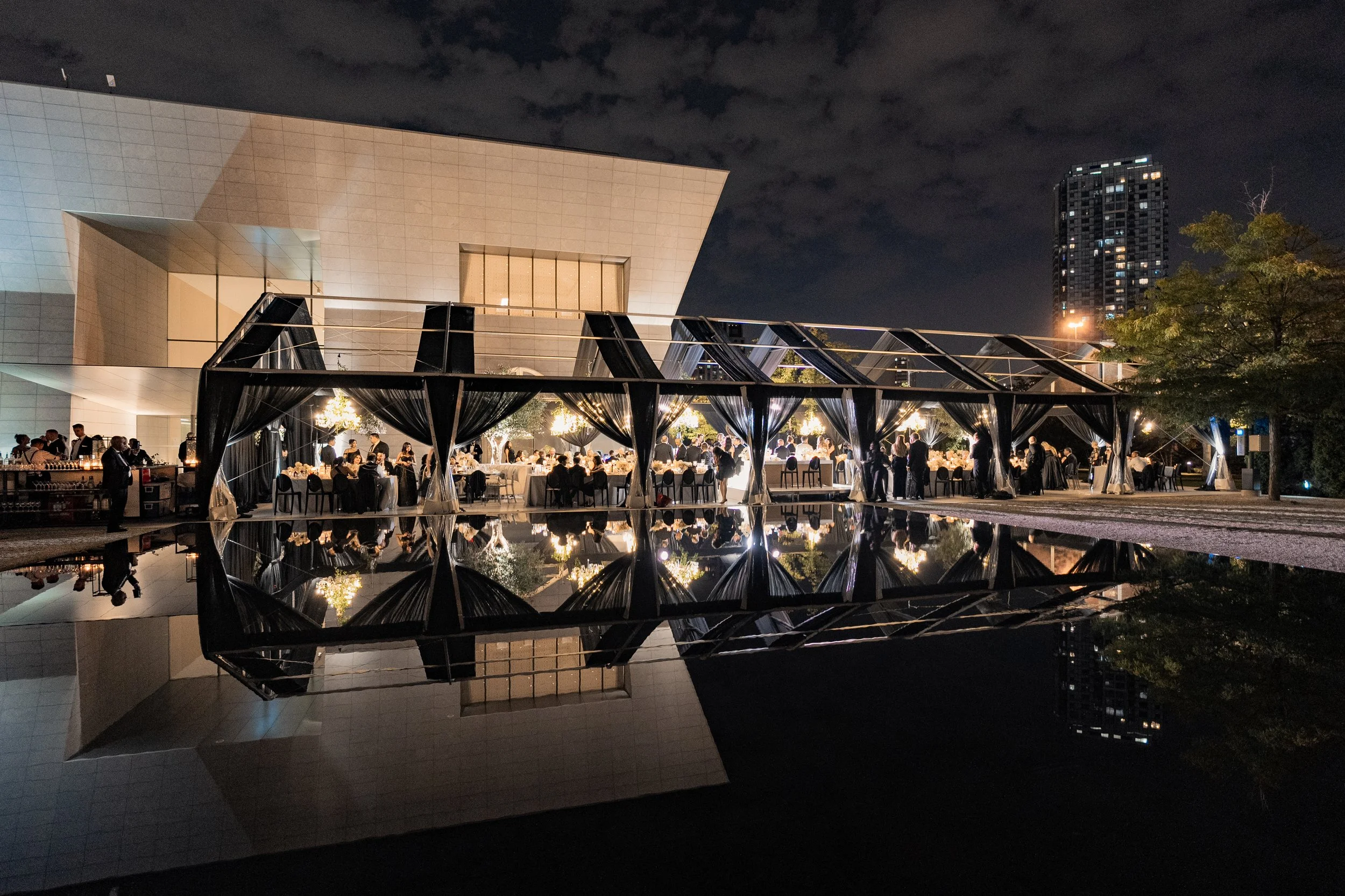
For weddings, the museum offers two primary event zones: the outdoor Courtyard for ceremonies and cocktail receptions, and the adjacent grounds where a temporary clear-top marquee tent can be erected for dinner receptions. The tent footprint, positioned adjacent to the reflecting pool, creates one of the most photographed wedding settings in Toronto — a glowing, chandelier-lit pavilion perfectly mirrored in the still water below.
Venue Detail
Information
Full Name: Aga Khan Museum
Address: 77 Wynford Drive, Toronto, ON M3C 1K1
Neighbourhood: Don Mills / Flemingdon Park
Ceremony Space: Outdoor Courtyard (by the museum's glass pyramid)
Reception Space: Clear-top marquee tent on museum grounds
Cocktail Space: Museum courtyard, terraces, and gallery foyers
Tent Capacity: Up to 300 seated guests for dinner reception
Ceremony Capacity: Approx. 200 (outdoor courtyard)
Photographer: Jasmine & Anuj: Mango Studios, Toronto
Wedding Date: August 24, 2024
Design Studio: Ethereal Creators (etherealcreators.com)
The Design Concept: White Garden
When Jasmine and Anuj first described their vision — an all-white palette, modern and minimalist, but with natural warmth and a sense of living, breathing beauty — the Aga Khan Museum's architecture became the framework rather than just the setting.
The design concept Ethereal Creators developed was called White Garden: a palette of pure white blooms, cool gunmetal and polished chrome, warm ivory linens, and the organic anchor of a living 14-foot olive tree at the reception's heart. Every element spoke in opposites that resolved into harmony — cool architecture and warm botanics, mirror and matte, structured metal and cascading flowers.
"The Aga Khan Museum's architecture is already a work of art. Our job was to speak its language — pure geometry, restrained palette, and then let one living tree bring it all to life."
The Ceremony: White Altar Against the Glass Pyramid
The Aga Khan Museum's outdoor courtyard is unlike any other ceremony space in Toronto. On three sides, guests are enclosed by the museum's pale limestone walls. On the fourth, the building's most dramatic architectural feature rises into the sky: an angular glass-and-steel diamond skylight, each facet reflecting the clouds and tree canopy in shifting geometric patterns. There is no arch, no draping, and no floral installation in the world that competes with this backdrop — so Ethereal Creators didn't try to compete with it. They designed the ceremony decor to complement it.
The Altar Platform
At the ceremony's focal point sat a custom round altar platform — a low, wide circular stage with a polished gunmetal and chrome curved surround that caught the light like liquid metal. The platform's reflective surface echoed the museum's own glass panels, creating a visual conversation between the ceremony design and the building behind it.
Atop the altar platform, two massive low-mounding floral arrangements framed the officiant's microphone stand — one on each side. Each arrangement was built in the low, dense, cloud-style that has become an Ethereal Creators signature: white cloud garden roses, white ranunculus, white dahlias, and white hydrangea packed so closely together they read as a single undulating mass of white. No height. No vertical stems. Just an unbroken horizon of white bloom that drew the eye straight to the couple and the pyramid behind them.
The Aisle
The ceremony aisle was defined by a black marble and granite tile runner — dark, reflective, and perfectly aligned with the platform's chrome accents. White Victoria Ghost chairs flanked both sides, their translucent polycarbonate frames barely visible from a distance, making the aisle feel open and unobstructed while providing elegant seating for guests.
The combination of the dark aisle, white ghost chairs, white flowers, and chrome altar against the pale limestone and glass architecture created a photograph that needed nothing else — no floral aisle markers, no petal scatter, no additional installations. The restraint was the design.
The Reception: Clear-Top Tent & the Living Olive Tree
If the ceremony was restraint, the reception was abundance — but abundance in a single, considered direction. The entire tent reception was designed around one central decision: a living, 14-foot olive tree, planted in the center of the reception floor and allowed to become the axis around which every other element orbited.
The Clear-Top Marquee Tent
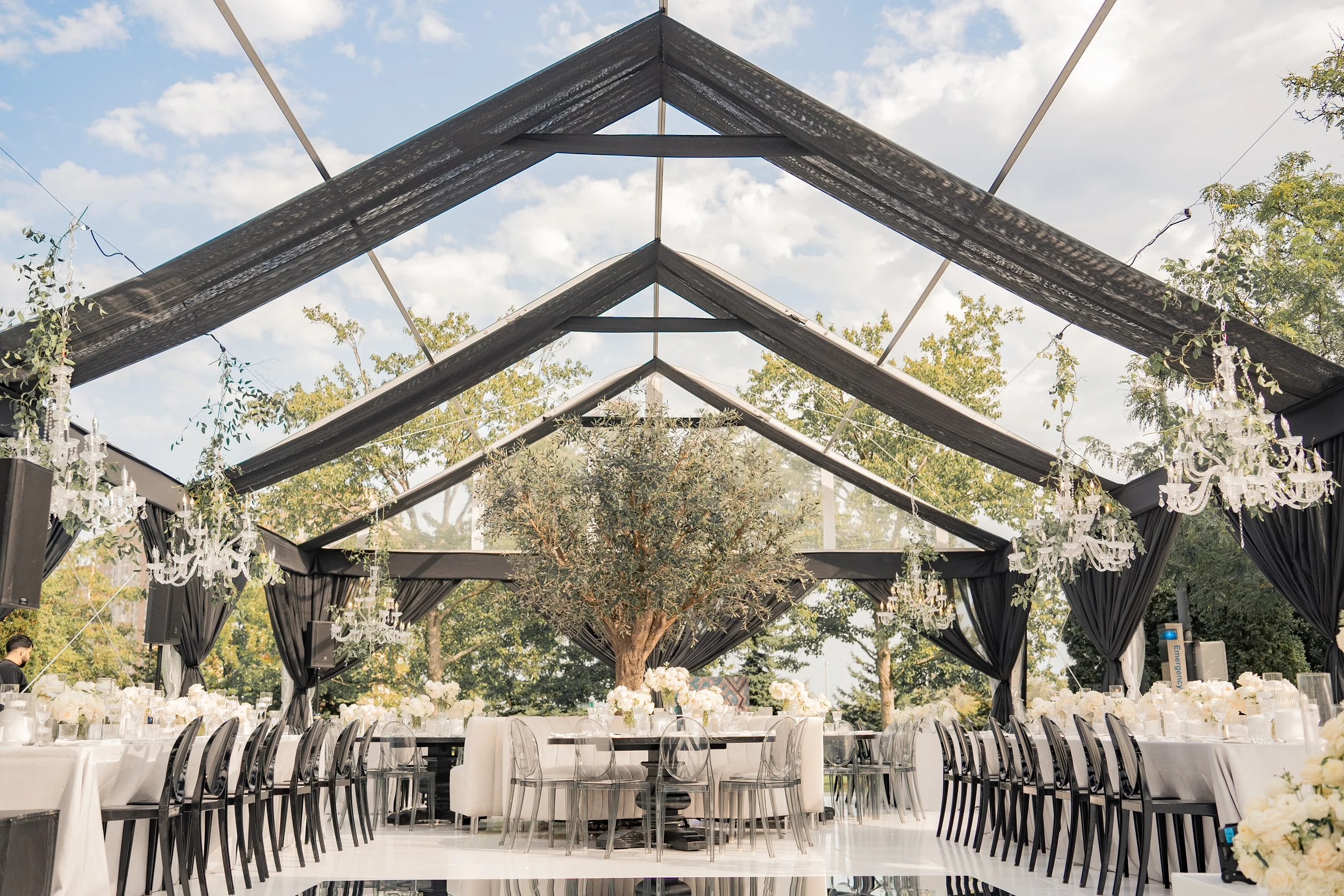
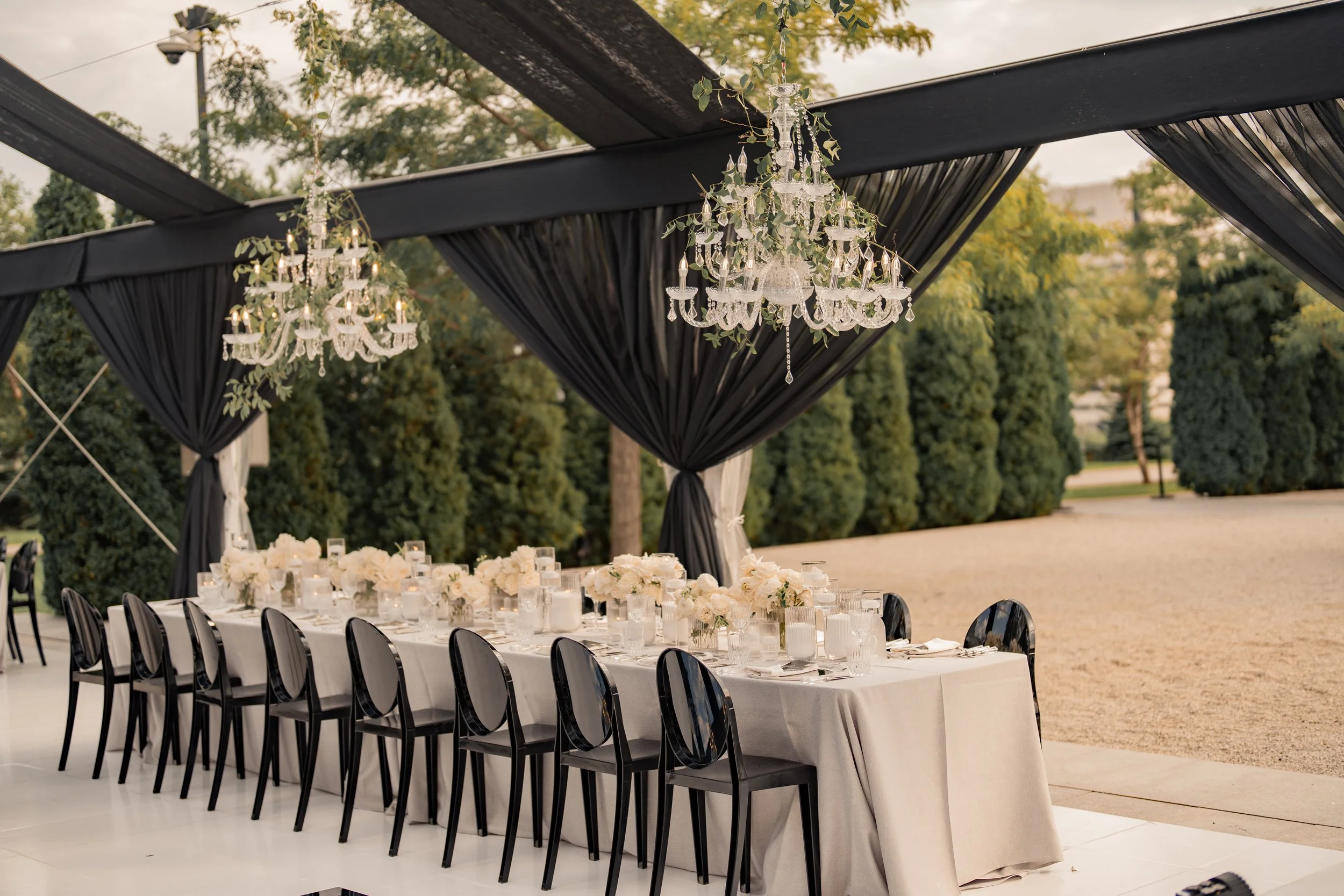
The reception was held in a bespoke clear-top marquee tent positioned on the museum's grounds, directly adjacent to the reflecting pool. The tent's structure featured black powder-coated steel beams and ridge poles that created a graphic architectural grid overhead — a dark framework that contrasted dramatically with the clear panels above, through which guests could see the open sky, shifting from blue afternoon clouds to a deep evening navy as the reception progressed.
The tent sidewalls were dressed in full-length black draping — charcoal-black fabric that fell from the eaves to the floor, creating the sense of a contained, intimate space while the clear ceiling maintained connection to the natural garden beyond. This interplay of closed walls and open sky became the tent's defining tension: enclosed and expansive at once.
The Living Olive Tree
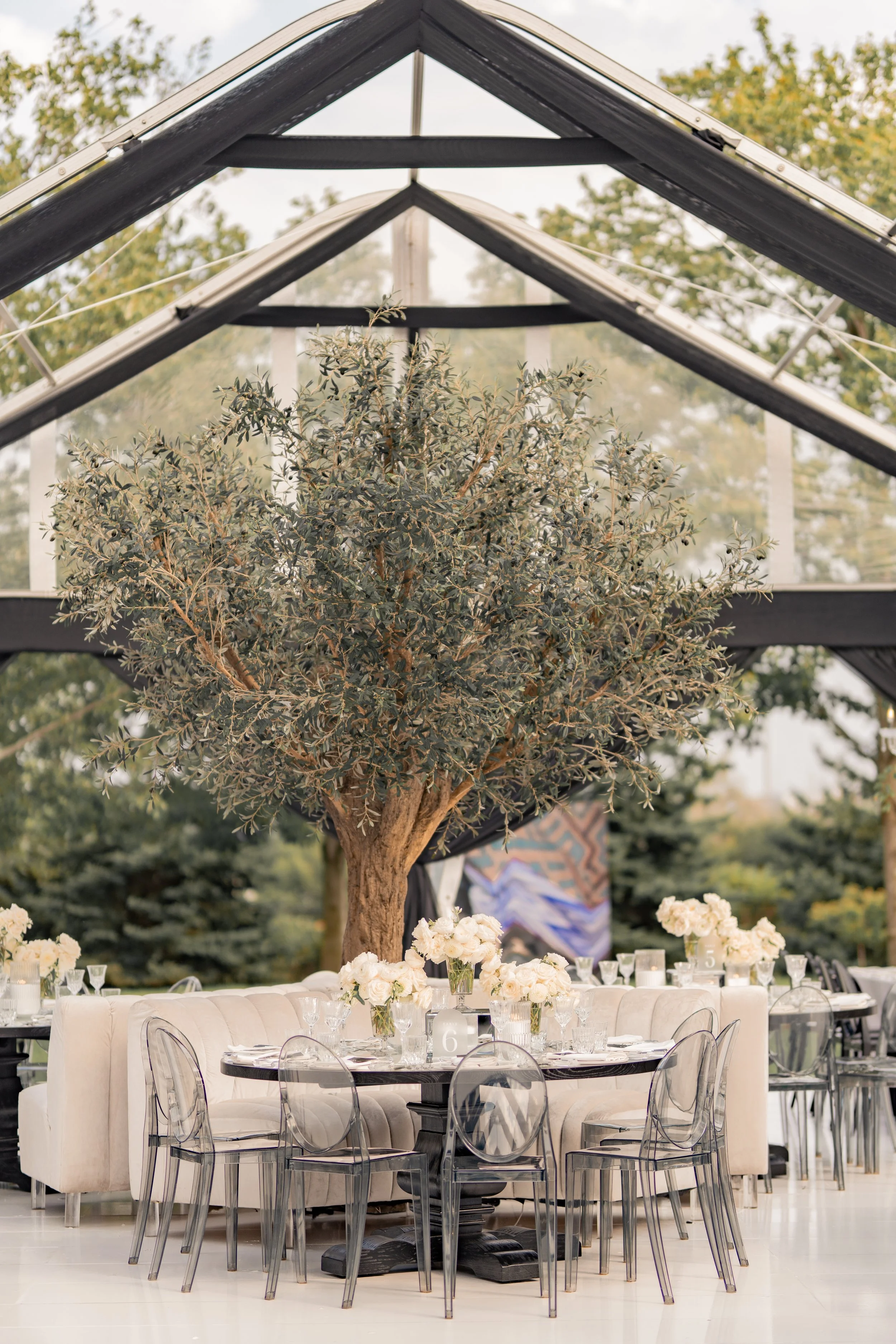
The 14-foot live olive tree was the single most impactful element of the entire reception design. Positioned at the precise geometric center of the tent, its gnarled silver-grey trunk and softly cascading grey-green canopy brought an organic, ancient warmth that nothing manufactured could replicate. An olive tree in a white glam wedding — it should not have worked. It worked completely.
The tree served four design functions simultaneously: it was a vertical focal point for the eye on entering the tent; it created a natural canopy under which the central lounge arrangement sat; its silver-grey bark tones perfectly harmonized with the smoke ghost chairs and chrome tableware; and its botanical greenery provided the only colour in the palette beyond white, silver, and black — making every floral arrangement read more brilliantly by contrast.
Crystal Chandeliers
From the tent's black steel ridge beams hung an array of crystal chandeliers — classic arms-and-drops designs with trailing greenery and eucalyptus woven through their frames, softening the crystal's formality with something alive. The chandeliers were positioned at staggered heights throughout the tent, creating a layered ceiling landscape that sparkled against the dark draping of the sidewalls.
By night, the chandeliers became the tent's primary light source, their hundreds of crystal drops fracturing and scattering the warm light across every white floral arrangement and polished surface in the room — an effect that intensified as the evening darkened and the tent began to glow from within.
The Gallery Tables & Round Tables
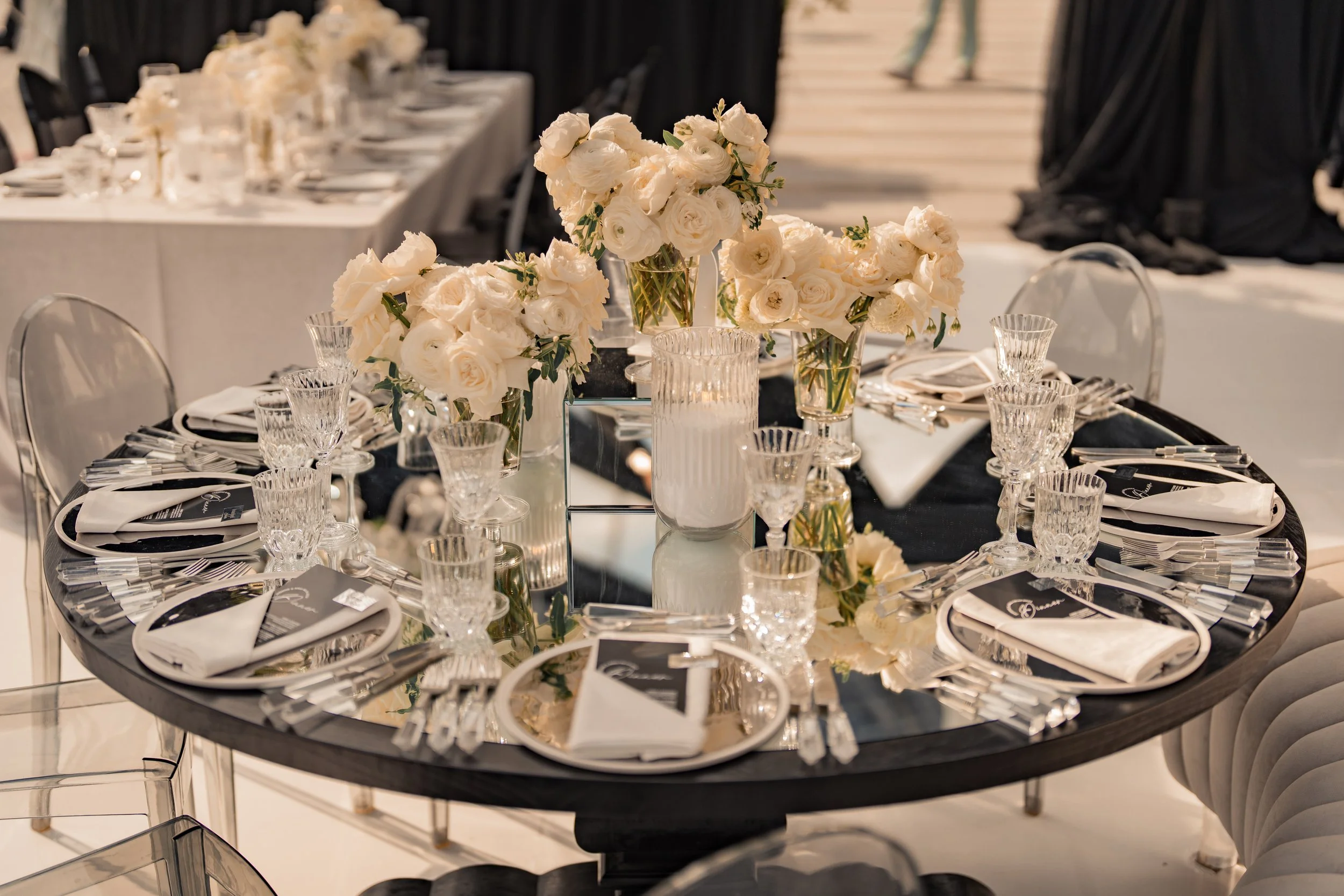
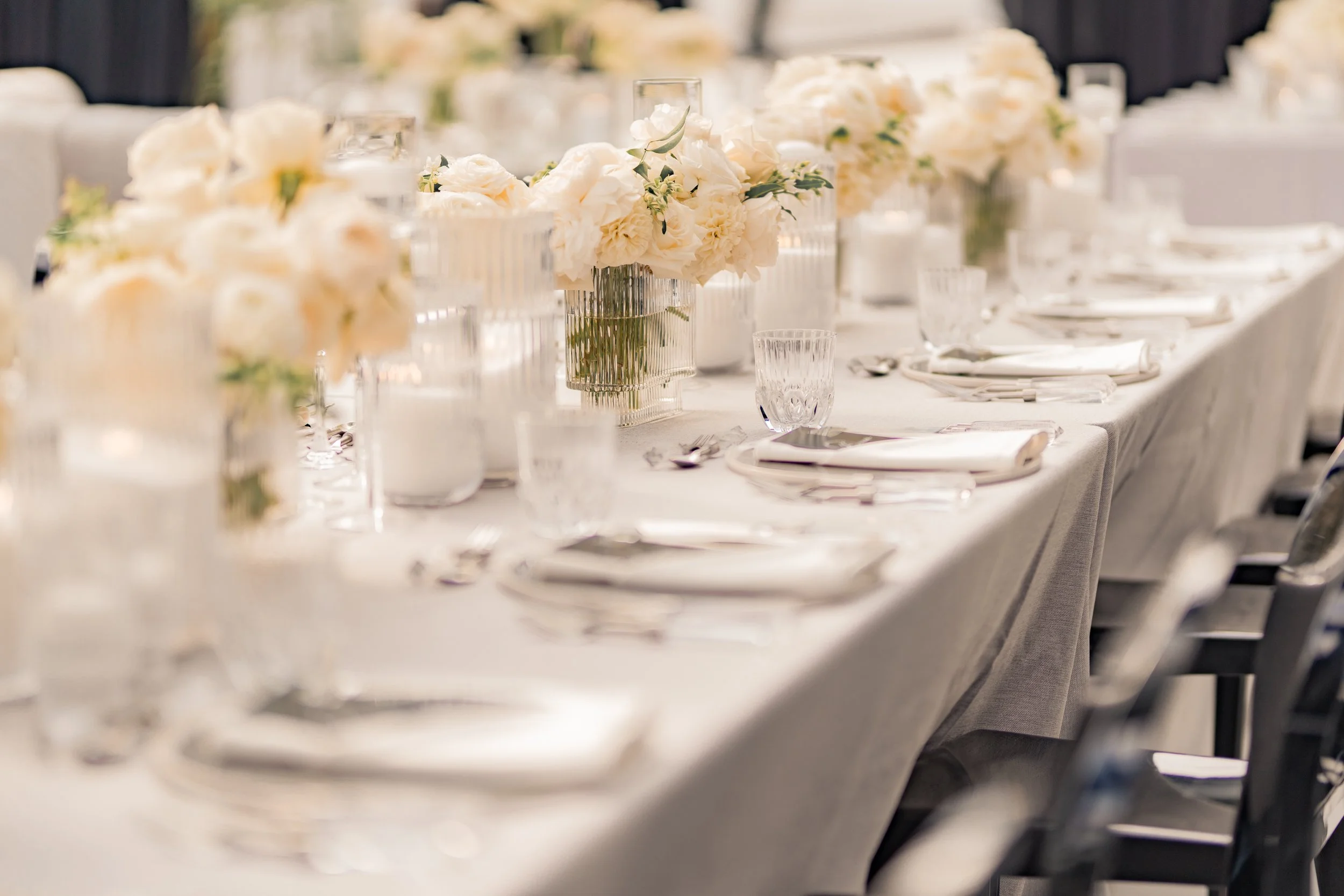
The reception seating mixed long 8-foot gallery tables with standard round tables — a layout that allowed for both intimate round-table conversation and the dramatic, communal sweep of a long table laden with white florals and candlelight. All tables featured a dark mirrored-top surface (black mirror), silver charger plates, crystal glassware, and low compact white floral centerpieces — cloud garden roses and ranunculus in clear and silver vessels kept below eye level to allow unobstructed sightlines across the room.
The Fluid Art Backdrop & Sweetheart Table
Behind the olive tree, positioned as a visual anchor for the room's central axis, hung a large abstract fluid art painting — deep blue, indigo, and gold poured and blended into an organic pattern that introduced the only warm colour note in the palette. Against the all-white and silver room, the painting was a deliberate interruption: a reminder that no design is truly monochromatic, and that one unexpected element can define everything around it.
The sweetheart table was set on a raised white platform positioned at the far end of the tent, on the room's central axis. Its platform edge was dressed in tiered white rose garden arrangements — dense, full, and tall enough to create a stage-like presence. Jasmine's Louboutin red sole, glimpsed as the couple danced, was the only red in the entire room — and perhaps the most intentional.
The Mirror Dance Floor
The dance floor was a large reflective mirror surface — black-tinted and high-gloss, it reflected the chandeliers above and the white floral arrangements around its perimeter, doubling every light source in the room. When the couple took their first dance, the floor became a second layer of the room — a reflection that moved with them and expanded the visual field of the tent downward as well as upward.
As the evening reception reached its height, a photographer stepped outside onto the reflecting pool terrace and captured what may be the single most iconic wedding photo taken at the Aga Khan Museum. The clear tent, blazing with chandelier light and movement, reflected perfectly in the still black surface of the 650-foot pool. The museum's angular facade glowed behind it. The Toronto skyline rose in the distance. It was not a photo that required much direction — it was simply the truth of where they were.
This is the Aga Khan Museum's gift to every couple who chooses it: a setting so architecturally and naturally extraordinary that the most powerful photographs of your wedding will come from simply standing in it. The design work is to be worthy of that setting — and to help every deliberately chosen element earn its place.
How to Design Your Aga Khan Museum Wedding
Every wedding at the Aga Khan Museum is different, but the couples who achieve the most visually cohesive results tend to follow a few principles. Having designed Jasmine and Anuj's wedding at this venue, here is what Ethereal Creators recommends:
1. Let the Architecture Lead
The Aga Khan Museum's architecture is one of the most sophisticated in Toronto. It speaks in a particular language: clean geometry, restrained material palette, precision and proportion. Your wedding design should speak that same language. If you come in with maximalist colour, elaborate printed draping, or chaotic florals, you will fight the building — and you will lose. Modern minimalism, architectural florals, and a restrained palette are the design vocabulary that amplifies the venue rather than competes with it.
2. Build Around One Dominant Element
Jasmine and Anuj's olive tree was that dominant element. Yours might be a different living installation, a different structural statement, or a different botanical anchor — but identify it early, build everything around it, and let it do the heavy lifting. A clear tent reception without a central visual anchor reads as a large empty room. Give the room a heart.
3. Design for Both Day and Night
The Aga Khan Museum's grounds are beautiful at every hour, but the venue genuinely transforms after dark. The reflecting pool exterior shot is only possible at night. Plan your decor, lighting, and photography around a 4-8pm timeline that lets you capture both the golden-hour courtyard ceremony and the nighttime tent-and-pool exterior. Brief your photographer on the reflecting pool shot specifically — it requires them to exit the tent and move to the pool terrace at the right moment.
4. Consider the Tent's See-Through Ceiling
The clear-top tent's ceiling is one of its greatest assets and its most demanding design constraint. Every element you hang from it — chandeliers, floral installations, draping — will be seen against the sky and the treetops, not against a solid surface. Test your scale accordingly. What reads as large in a ballroom may disappear against an open sky. Scale up your hanging elements, choose crystal or metallic materials that catch daylight, and layer multiple heights to create visual richness in the canopy zone.
5. The White Palette Works Exceptionally Well Here
The limestone-and-glass building and its manicured grounds are essentially neutral — they will support almost any palette, but they are particularly generous to white and ivory. White florals against the limestone walls photograph as pure architectural sculpture. The reflecting pool turns any lit tent into something from a dream. If you are drawn to colour, consider using it as a single accent — a backdrop, a lighting wash, a bride's lehenga — rather than saturating the entire palette. The restraint pays off in photographs.
Frequently Asked Questions: Aga Khan Museum Weddings
Is the Aga Khan Museum a good wedding venue for South Asian couples?
Absolutely. The Aga Khan Museum's Islamic art and architecture heritage gives it a particular resonance for Muslim, Hindu, and South Asian couples who want a venue that honours their cultural roots while offering world-class architectural beauty. The outdoor courtyard and reflecting pool are especially powerful settings for Nikah ceremonies and South Asian wedding receptions, and the venue accommodates halal catering through its preferred partners.
Can I have my ceremony and reception both at the Aga Khan Museum?
Yes, and it is highly recommended. The venue's flow — ceremony in the outdoor courtyard, cocktails on the terrace and in the garden, dinner reception in the clear-top tent — creates a natural guest journey through different architectural zones over the course of the evening. Most couples book both the ceremony and reception on the same day, which also gives you access to the reflecting pool night exterior shot that is only possible when both events are on-site.
How far in advance do I need to book the Aga Khan Museum for a wedding?
The Aga Khan Museum is one of Toronto's most sought-after wedding venues and weekend dates are limited. Most couples secure their date 12 to 18 months in advance. If you have a specific date in mind — particularly for summer Saturdays in June through September — begin the booking conversation as early as possible. The venue's events team can advise on current availability.
What is the tent capacity for a dinner reception?
The clear-top marquee tent can accommodate up to approximately 300 seated dinner guests depending on the table configuration and dance floor size. A mix of long gallery tables and round tables — as Ethereal Creators designed for Jasmine and Anuj — allows for flexibility in layout and creates a more visually interesting room than a uniform round-table floor plan.
What decor style works best at the Aga Khan Museum?
The venue responds best to modern minimalist, architectural, and editorial design approaches. The building's clean limestone geometry, reflecting pool, and formal Islamic garden all speak a restrained visual language. Designs that embrace a limited palette — white and ivory, black, gold, silver, or blush — and that use one strong focal element (like the olive tree used at Jasmine and Anuj's wedding) tend to produce the most cohesive and photographically powerful results. Maximalist colour palettes or ornate printed draping can fight the building's natural aesthetic.
Can Ethereal Creators design and execute a wedding at the Aga Khan Museum?
Yes. Ethereal Creators has designed and executed weddings at the Aga Khan Museum and is familiar with the venue's physical constraints, load-in logistics, tent erection timelines, and vendor coordination requirements. If you are planning a wedding at the Aga Khan Museum and would like to work with a luxury floral and décor studio that has real experience on this property, contact Ethereal Creators at etherealcreators@gmail.com or visit etherealcreators.com.
Does the Aga Khan Museum allow outside vendors for floral and decor?
The Aga Khan Museum allows couples to bring in their own floral and décor vendors, though some categories — catering and bar service — are managed through the venue's preferred partners. Your event coordinator at the museum will provide a full list of vendor restrictions and requirements during the planning process. Ethereal Creators works frequently with the venue's operational team and is familiar with the installation and strike requirements.
What makes the Aga Khan Museum different from other luxury Toronto wedding venues?
The Aga Khan Museum is the only Toronto wedding venue where the building itself — a Fumihiko Maki architectural landmark — is a design element in its own right. The reflecting pool exterior at night is unique in the city. The Islamic garden setting is unlike any Toronto hotel ballroom or historic estate. And the venue's combination of outdoor ceremony space and clear-top tent reception allows couples to experience the sky, the gardens, and the architecture throughout their entire wedding day — not just during photos.