
Church Wedding vs Venue Ceremony: Which Is Right For Your Toronto Day?
One of the first decisions Toronto couples make — usually before the venue is even booked — is whether to have a church wedding or an on-site venue ceremony. It feels like a simple question, but the downstream effects on cost, logistics, guest experience, and the emotional arc of the day are significant. If you're comparing church wedding vs venue ceremony options for your Toronto wedding, this guide breaks down the real trade-offs across five dimensions we see couples weigh in every consultation. None of this is about which option is "right" — only which is right for how you want the day to feel.
The Big Emotional Difference (It's Not What You Think)
Most couples assume the emotional difference is about religion or tradition. It's not. The real difference is whether your ceremony feels like a pilgrimage or a transition.
A church wedding asks your guests to travel somewhere intentional. They park, they enter a sacred space, they sit in silence, they witness, and then they leave together and travel again to the celebration. That shift creates a ritual arc — a distinct "before" and "after" — that guests physically feel.
A venue ceremony is a transition, not a pilgrimage. Guests arrive once, sit for the ceremony, stand up, turn around, and walk into cocktails. It's seamless, lower-friction, and absolutely beautiful when designed well — but it can feel more like "the first act of the party" than a separate sacred moment.
Neither is better. But couples who choose a venue ceremony and want it to feel meaningful have to work harder at the design layer — a separate room, dramatic florals, distinct music, even a scent cue — to recreate the emotional shift a church delivers automatically. If you're someone who deeply values ritual and separation, that's a data point. If you prioritize flow and your guests' comfort, that's a different data point.
Logistics: Guest Flow, Transport, and Turnaround Time
Here's where the church path gets complicated. A church ceremony creates a 2–3 hour gap between the end of the service and the start of cocktail hour at your reception venue, once you factor in:
Church recessional and receiving line: 20–30 minutes
Travel from church to reception: 30–60 minutes in Toronto traffic
Portraits during the gap: 60–90 minutes
Guest arrival buffer at reception: 30 minutes
During that window, your guests need somewhere to go. Most couples book a nearby hotel lobby lounge, a cocktail bar, or a restaurant where guests can gather before reception doors open. Some hire a shuttle to solve the transport problem entirely. Either way, it's a logistics layer that doesn't exist with a venue ceremony.
A venue ceremony collapses this entirely — ceremony ends at 4:30, guests move to a different room for cocktail hour at 4:45, dinner at 6:30. Clean, simple, no transport, no "what do we do now" moment for guests.
The tradeoff: venue ceremonies require your venue to have two distinct usable spaces (ceremony room + cocktail room + dining room, ideally all different), plus a room flip during dinner if you're reusing the ceremony space.
"Coordinating a church ceremony + offsite reception has twice the logistics of a single-venue wedding — if you're unsure whether you need a planner, a designer, or both, our wedding planner vs designer guide breaks down exactly what each role handles."
Example: St. Clement’s Church — Chantol & William
We created a lush green-and-white floral garden that framed the front beautifully without touching the church’s architecture.
Officiant Rules & What Each Setting Requires
Church ceremonies have rules, and they vary by denomination:
Catholic churches in Toronto — usually require at least one partner to be a baptized Catholic, parish registration, six months' notice, completion of a marriage preparation course, and no readings or music outside the approved Catholic liturgy. Some parishes also restrict who can be in the wedding party.
Anglican and United Church — more flexibility on readings, music, and pre-marriage requirements. United Church is generally the most accommodating of interfaith or non-religious couples who still want a church setting.
Orthodox churches — strict liturgy, no photography during certain portions, and specific requirements about wedding party religion.
Non-denominational chapels — closer to a venue ceremony in flexibility, with a church's visual atmosphere.
Venue ceremonies let you use any officiant registered in Ontario — a civil celebrant, a religious officiant not affiliated with a specific parish, or even a friend who becomes a one-day registered solemnizer through the Ontario government. You write the ceremony you want, choose the music you want, and invite whoever you want to read.
One non-negotiable for both paths: you need a marriage license from any Ontario municipality at least five days before the wedding. Toronto City Hall issues them for $170 on a walk-in basis.
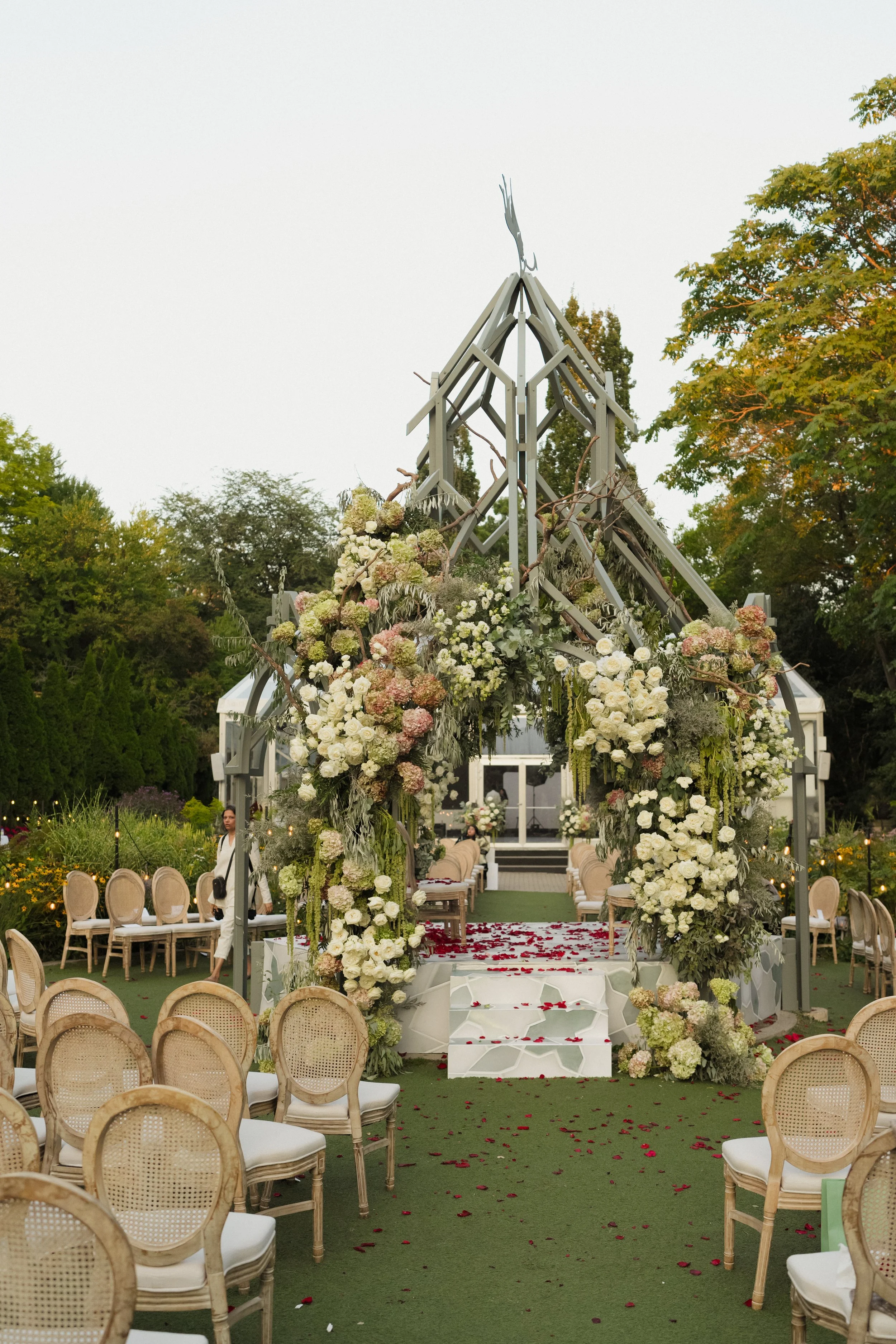
Example: Casa Loma — Sapphire & Nadeen
Palette: Greens, branches, hydrangeas, roses
We leaned into the timeless architecture while adding softness and movement with florals.
Design Freedom: What Each Location Lets You Do
This is the dimension where venue ceremonies win clearly.
Inside a Toronto church, your design options are usually limited to:
Aisle florals (pew markers, petals on the runner, small arrangements on alternating pews)
Altar arrangements (2–3 florals flanking the altar, occasionally a cross or tabernacle accent)
Ceremony flowers that can be repurposed at the reception
Churches rarely permit: aisle runners beyond what's already installed, ceiling treatments, candle installations (fire code), floral chandeliers, large-scale arches that block sight lines, or anything that attaches to altars or statuary. Decor approval is almost always required from the parish office 30–60 days in advance.
A venue ceremony gives you a blank canvas. You can design a full floral arch, a ceremony aisle with a floral runner or custom rug, a chuppah or mandap, suspended floral installations, dramatic lighting, a specific seating layout (asymmetrical, in the round, or traditional), and a branded guest book or welcome moment. If design freedom is high on your priority list, a venue ceremony almost always wins — and our Toronto wedding ceremony decor guide walks through every element in detail.
The one caveat: design freedom costs money. A bare church ceremony with $2,000 of florals can feel stunning because the architecture does the work. A bare venue ceremony with $2,000 of florals can feel under-designed because the room is usually neutral.
"Whichever path you choose, there are line items neither venue contract will spell out — guest shuttles, cocktail hour extensions, officiant gratuities, corkage, and rigging fees. We break them all down in hidden wedding costs most couples miss."
Cost Breakdown: Real Numbers for Each Path
Here are the actual ceremony-specific line items for each path, based on Toronto weddings we've designed:
Church ceremony path
Church donation or fee: $500 – $1,500
Altar and aisle florals: $1,500 – $3,000
Guest transport (optional shuttle): $800 – $2,500
Officiant gratuity: $100 – $300
Musicians (organist or string duo): $400 – $1,200
Total ceremony cost: approximately $3,300 – $8,500
Hidden cost people miss: the cocktail hour extension at the reception venue if guests arrive earlier than planned, or the bar tab if you host guests somewhere in between. Budget $1,500–$3,000 extra for this.
Venue ceremony path
Venue ceremony fee: $1,500 – $4,000
Ceremony floral arch or focal point: $2,500 – $8,000
Aisle treatment and seating florals: $1,500 – $4,000
Officiant: $300 – $800
Ceremony musicians: $400 – $1,500
Optional ceremony ceiling element: $2,000 – $6,000
Total ceremony cost: approximately $6,200 – $24,300
On paper the church path looks cheaper — and it often is by a few thousand dollars. But factor in transport, gap-hour hosting, and the emotional priority you place on each element, and the gap narrows considerably. Both paths can create an unforgettable day; the question is which set of trade-offs fits the wedding you actually want.
"One of the most effective ways to make a neutral venue ceremony space feel sacred — the way a church does automatically — is overhead design. Ceiling treatment rentals in Toronto can transform a bare ballroom into a room that feels ceremonial the moment guests walk in."
FAQ Church wedding vs venue ceremony
Q1. Is it cheaper to have a church wedding than an on-site venue ceremony?
Church donations are usually $500-$1,500, while a venue ceremony fee is typically $1,500-$4,000 on top of reception costs. But factor in transportation, cocktail hour extension if you need to bridge the gap, and double decor — the all-in numbers often come out similar.
Q2. Do I have to be religious to have a church wedding in Toronto?
Most Catholic, Anglican, and Orthodox churches in Toronto require at least one partner to be a member of the denomination or to complete preparation classes. United Church and non-denominational spaces are the most flexible. Always call the parish office to ask about their specific requirements.
Q3. How do you make an on-site venue ceremony feel meaningful?
A separate, designed ceremony space — even within the same venue — creates the shift. We use a different room, dramatic florals, a distinct aisle treatment, and sometimes music and lighting cues to make the ceremony feel sacred and separate from the reception.
Q4. What's the typical timeline gap between a church ceremony and venue reception?
Plan for 2-3 hours between the end of the church service and the start of cocktail hour at your reception venue, factoring in photos, travel, and guest arrival. Many couples use this window for portraits and give guests a refreshment stop recommendation.