
Wedding Ceiling Installations Toronto: Behind the Magic
The Fifth Wall Nobody Talks About
There are four walls in any ballroom. Every couple plans what happens on them — the draping, the backdrops, the entranceway. But the ceiling? That is the fifth wall. The one that covers every single guest from above. The one that appears in every wide-angle photograph. The one that defines the entire atmosphere of a room before a single table is set.
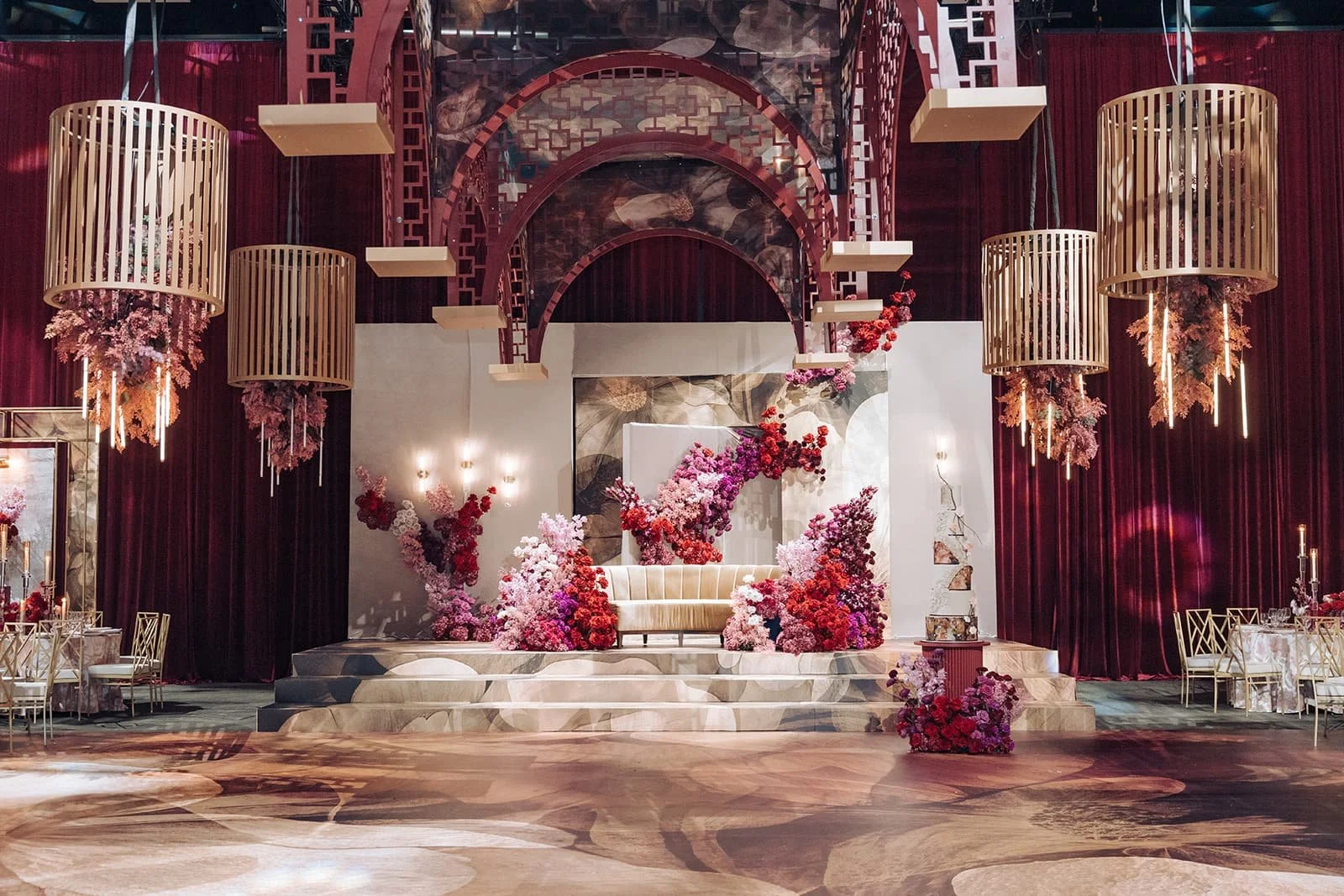
When Ethereal Creators began designing the ceiling installation for Harneet and Gary's 526-guest wedding at Universal Event Space, we started — as we always do — with a blank scaled drawing of the ceiling and a single question: what should guests feel the moment they look up?
The answer took 9 pages of rigging plans, a full truss system across the venue's main floor, suspended arch and drum elements, zoned fabric treatments, and a team working through the night before the wedding. This blog takes you through every step — because we believe the couples who understand what goes into ceiling work are the couples who end up with the most extraordinary rooms.
What Is a Wedding Ceiling Installation — Really?
Most people think of ceiling décor as fabric draped across a venue and left at that. But a true ceiling installation is an architectural intervention — a designed system of structural, decorative, and lighting elements that transforms overhead space into something that feels intentional rather than incidental.
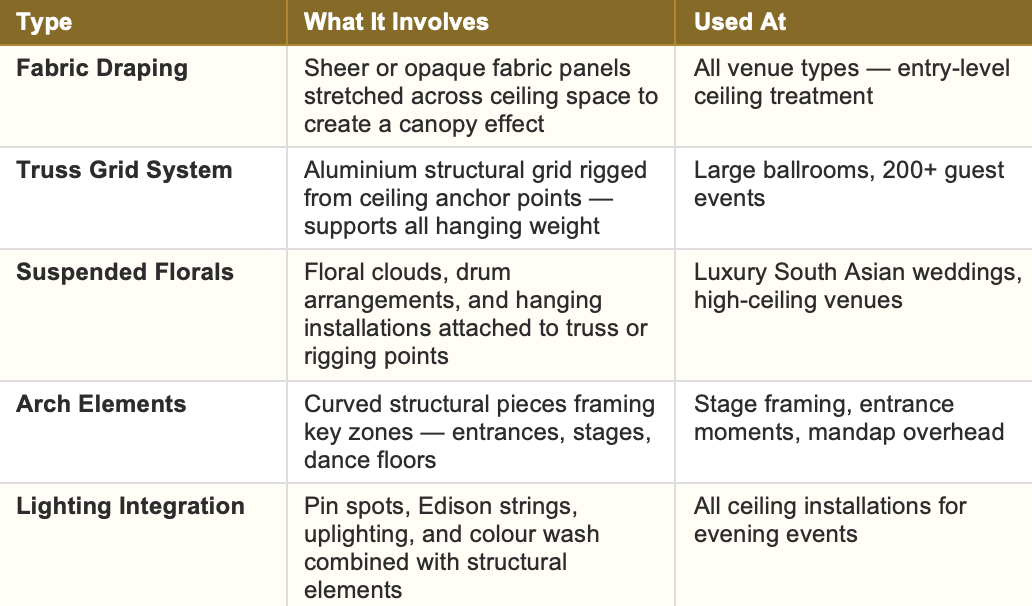
At Ethereal Creators, we break ceiling work into five distinct categories, and most large-scale weddings combine several of them:
Step 1: The Ceiling Plan — Before a Single Piece of Fabric Is Cut
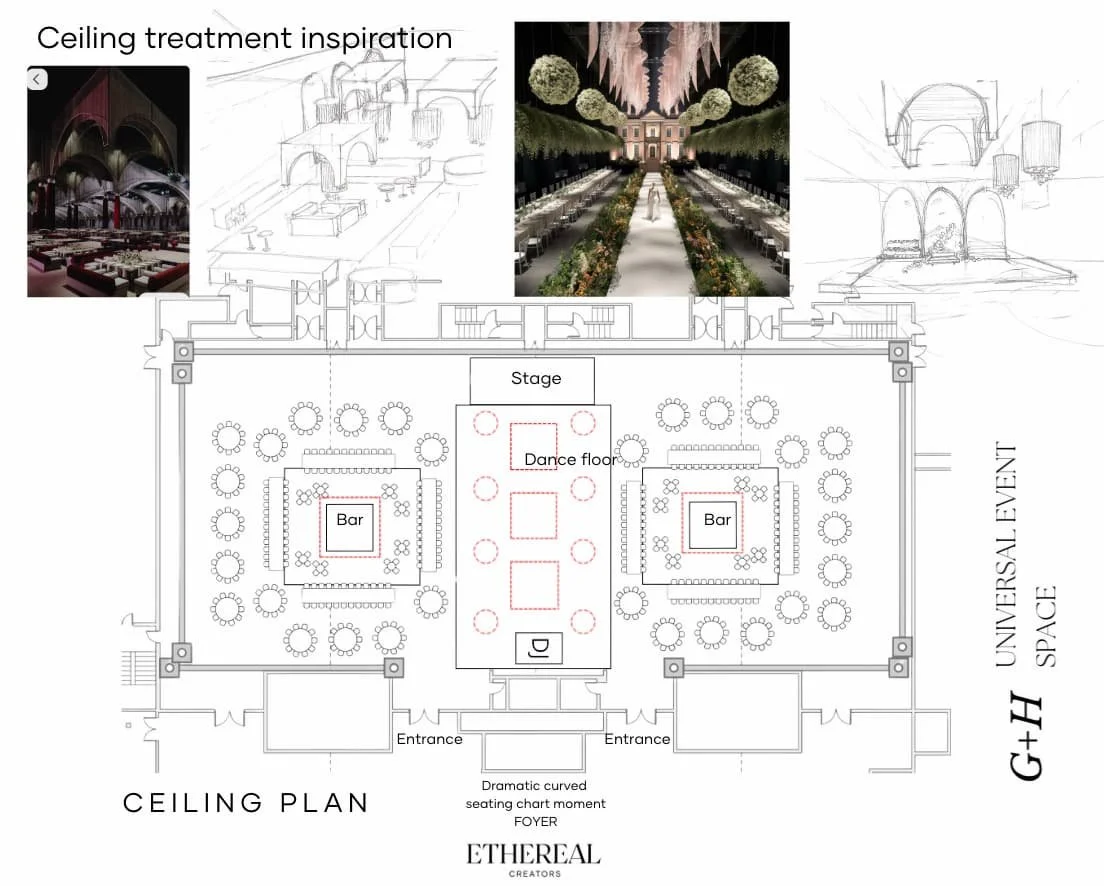
Every Ethereal Creators ceiling installation begins with a scaled ceiling plan drawn to the exact dimensions of the venue. This is not an afterthought — it is the foundation of everything that follows. Get the plan wrong and the installation day becomes a crisis. Get it right and the entire team moves with precision.
For Harneet and Gary's wedding at Universal Event Space, our ceiling plan mapped out the full room across key zones — entrance and foyer, main dining floor, dance floor, stage, and dual bar areas. Each zone received a specific treatment based on its function, ceiling height, and sightline importance.
📐 WHY A CEILING PLAN MATTERS
A ceiling plan is to a décor team what blueprints are to a construction crew.
It answers five critical questions before installation begins:
1. Where are the venue's rigging/anchor points?
2. What load can each point safely support?
3. Which zones get which treatment?
4. How many linear feet of fabric are needed?
5. Where does lighting integrate with structural elements?
Without a ceiling plan, teams improvise on installation day — and improvisation
at height, with weight, is how things go wrong.
Step 2: The Truss System — The Backbone You Never See
If the ceiling plan is the blueprint, the truss system is the skeleton. A truss is an aluminium structural framework — a grid of interlocking beams — that is rigged from the venue's ceiling anchor points to create a horizontal surface at a set height from which everything else hangs.
For non-technical couples, the easiest way to understand a truss is to picture the metal scaffolding grid you see above a concert stage — the thing all the lights and equipment hang from. At a wedding, the truss works the same way, except it is dressed in fabric, flowers, and light rather than speaker arrays.
Why Can't You Just Attach Fabric Directly to the Ceiling?
Excellent question — and one we hear at nearly every consultation. Some fabric treatments can attach directly to a ceiling using hooks or adhesive rigging, but for anything involving weight — suspended florals, hanging drums, fabric tension across large spans — you need a load-rated structure. Direct ceiling attachment points at most venues are not rated for significant hanging weight. A truss distributes that weight across multiple rated anchor points, keeping everything safe and level.
TRUSS SYSTEM BASICS — WHAT YOUR DÉCOR TEAM NEEDS TO KNOW
• Venue must confirm rigging/anchor point locations and weight ratings
• Truss beams are typically 6.5' sections bolted together to span the space
• For Universal Event Space (40' main span), multiple truss runs are required
• Each suspended element (drum, arch, fabric) has a load calculation
• Setup typically starts 8–12 hours before guests arrive
• A licensed rigger or experienced installation team must execute the work
• All rigging is inspected before guests enter the room
Step 3: Designing the Zones — Not Every Ceiling Needs the Same Treatment
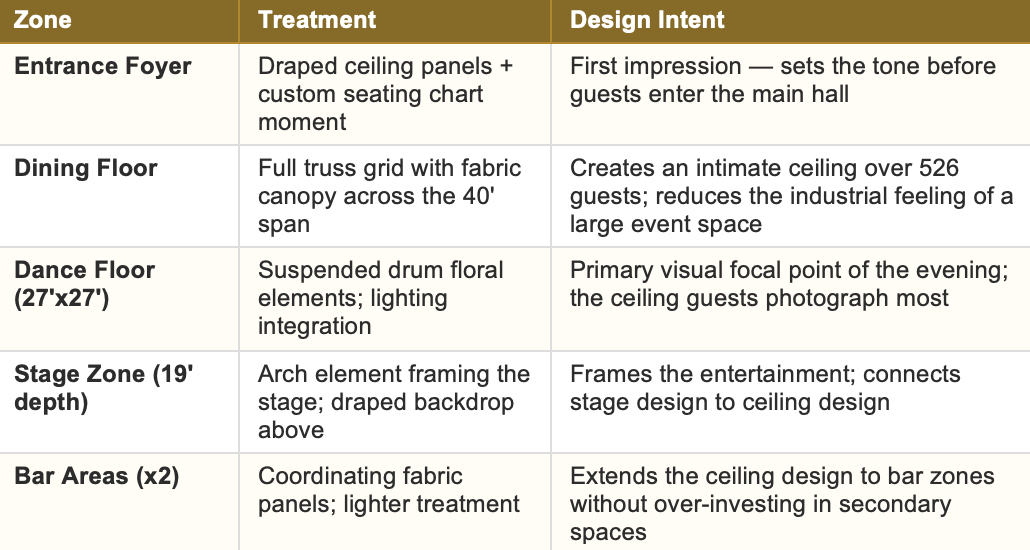
One of the most common mistakes in ceiling design is treating the entire ceiling as one canvas. In a large venue like Universal Event Space — which hosted 526 guests across dining, dancing, and bar areas — different zones have different functions, different sightlines, and different design needs.
Here is how we zoned Harneet and Gary's ceiling at Universal Event Space:
Step 4: The Suspended Elements — Drums, Arches & Floral Clouds
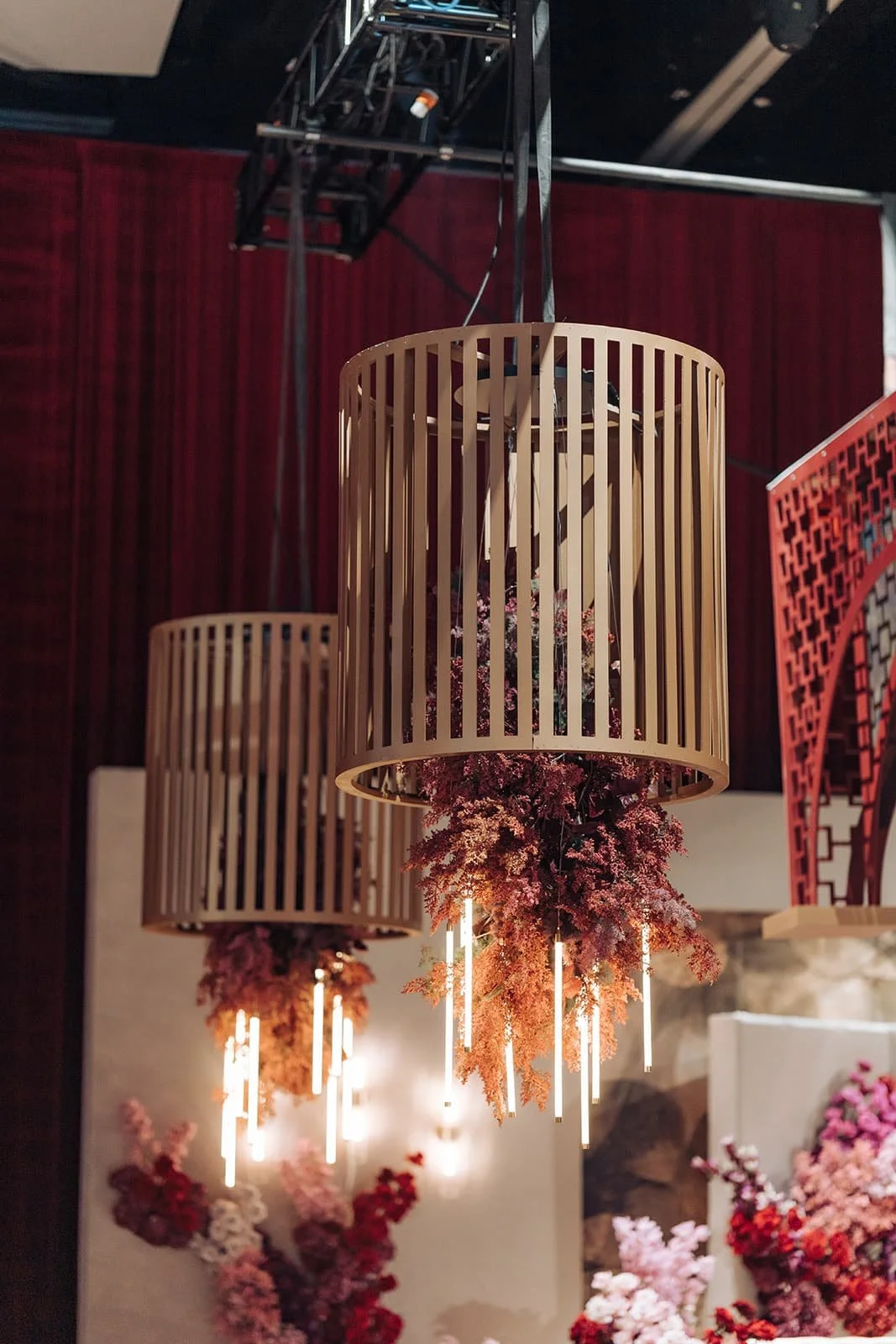
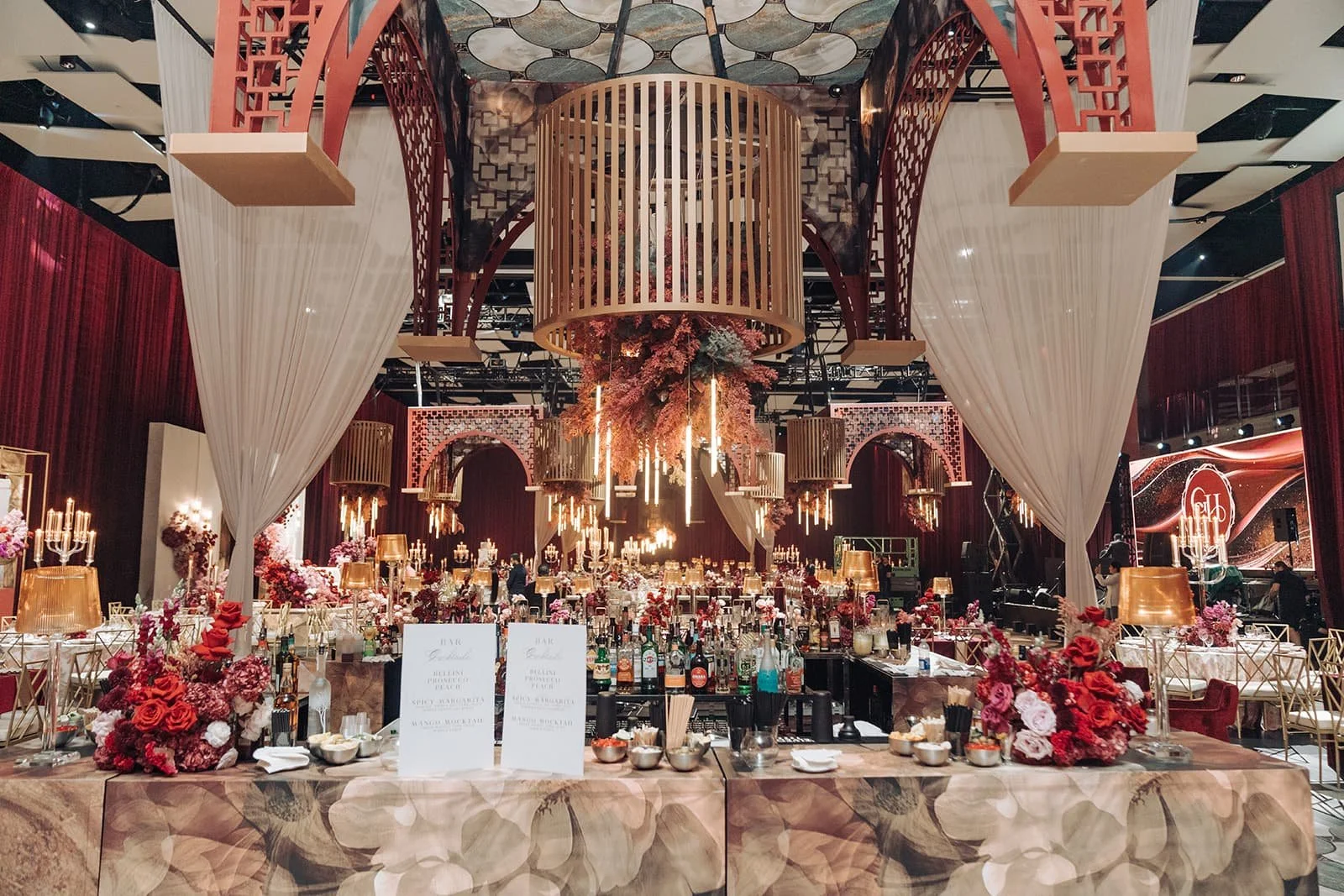
Once the truss grid is in place and the fabric canopy is installed, the suspended decorative elements go up. For Harneet and Gary's wedding, the two primary ceiling features were the drum arrangements over the dance floor and the arch element that marked the transition from dining to dancing.
What Are Drum Arrangements?
Drum arrangements are circular suspended structures — imagine a cylinder or hoop hung horizontally from the ceiling, filled with cascading florals, fabric, lighting, or a combination of all three. They are named for their shape, which echoes the drum, and they are placed directly above the dance floor for maximum visual impact.
For a 526-guest wedding, the dance floor is the most-photographed zone after the ceremony and head table. A drum arrangement directly overhead means that every wide-angle photo of the dance floor — and every shot looking up from the floor — includes this hanging jewel. It is one of the highest-ROI ceiling elements we install.
What Are Arch Elements in a Ceiling Design?
An arch element in a ceiling design is a curved structural piece that frames a transition — from dining area to dance floor, from foyer to ballroom, from stage to audience. Unlike a freestanding arch (which stands on its own footprint), a ceiling arch is suspended from the truss or rigging system, meaning it floats above the space rather than occupying floor area.
For Harneet and Gary's Universal Event Space installation, the arch was positioned at the boundary between the dining floor and the dance floor — creating a visual gateway that signalled to guests that they were entering the celebration space. When the lights dimmed for the first dance, that arch glowed above the couple and behind them in every photograph.
DRUM + ARCH: THE COMBINATION THAT DEFINES THE ROOM
The arch creates the frame. The drum fills the sky above the dance floor.
Together, they turn the centre of the room into a portrait — every photo taken
from the dining tables looks toward a composed, designed moment.
This is the ceiling design principle that most couples do not understand until
they see it in their photos: the ceiling is the background of half your images.
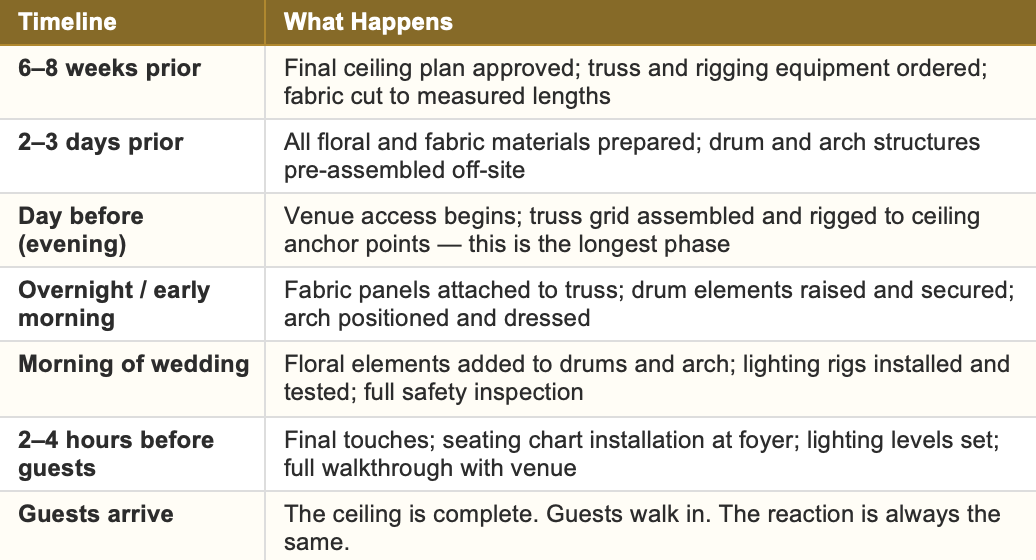
Step 5: Installation Day — The Timeline Your Florist Won't Show You
Here is the honest reality of a ceiling installation at a venue the scale of Universal Event Space: it does not happen during business hours. For a 526-guest wedding with full truss rigging, suspended florals, arch framing, and zone-by-zone fabric treatments, the installation team typically works from the previous evening or through the night.
What Does a Wedding Ceiling Installation Cost in Toronto?
We will always give a straight answer on this, because under-budgeting for ceiling work is the most common reason couples end up disappointed. The ceiling covers the entire room — it is by definition the largest décor surface. Here are realistic ranges for Toronto and GTA venues:
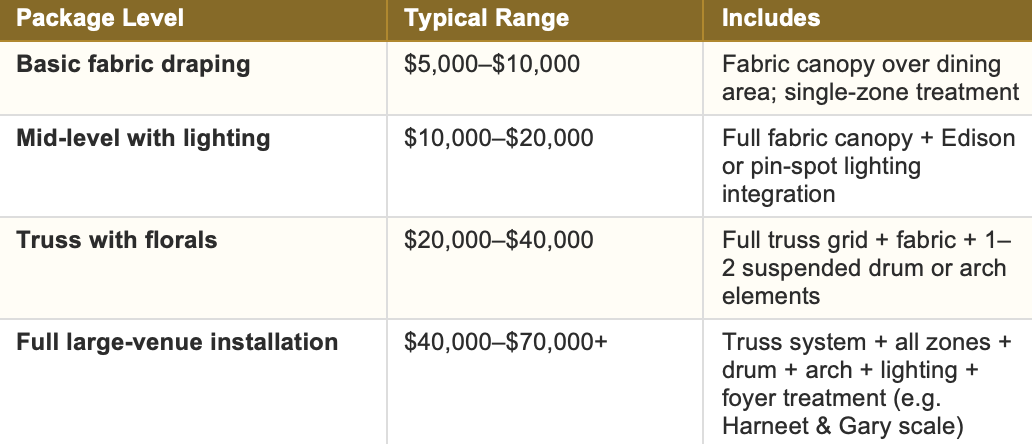
For reference: a mid-level ceiling installation at $15,000 across a 300-person venue works out to $50 per guest — often the same as upgrading every centrepiece by one tier. Most couples who have done both say the ceiling is the better investment, because it changes the entire room rather than one table.
Ceiling Installations at Toronto's Major Venues — What You Need to Know
Not all Toronto and GTA venues accommodate ceiling installations equally. Before you budget for ceiling work, here is what to ask and what to expect:
• Confirm rigging point locations and weight ratings in writing with your venue coordinator
• Ask if the venue requires a licensed rigger or permits your décor team to execute the work
• Check if there are restrictions on the type of rigging hardware allowed (some venues prohibit drilling or screws)
• Confirm load-in access — ceiling work requires early access, often the evening before
• Ask about ceiling height — installations behave very differently at 14' vs 24' ceiling heights
• Understand teardown requirements — some venues require full removal the night of the event
ETHEREAL CREATORS VENUE CEILING EXPERIENCE
We have executed ceiling installations at:
• Universal Event Space — full truss grid, 526 guests (Harneet & Gary)
• Royal Ambassador — large-scale South Asian wedding ceiling treatments
• Four Seasons Toronto — fabric canopy and suspended elements
• Shangri-La Toronto — ceremony and reception ceiling work
• Casa Loma — working within historic stone architecture constraints
Every venue is different. We survey every space before finalising a ceiling plan.
Frequently Asked Questions: Wedding Ceiling Installations Toronto
Q: What is a wedding ceiling installation?
A wedding ceiling installation is a decorative treatment applied to a venue's ceiling space using fabric draping, floral arrangements, lighting, or structural elements like arches and drums. It transforms the overhead space of a ballroom or event hall into part of the visual design.
Q: How much does a wedding ceiling installation cost in Toronto?
Wedding ceiling installations in Toronto typically range from $5,000 for basic fabric draping to $30,000–$60,000+ for full truss-rigged floral cloud and lighting systems at large venues. Cost depends on venue size, ceiling height, number of elements, and complexity of rigging.
Q: What is a truss system at a wedding?
A truss system is a structural aluminium grid suspended from a venue's ceiling or rigging points, used to hang heavy décor elements like fabric draping, floral arrangements, lighting rigs, and decorative arches safely. It is the backbone of any large-scale ceiling installation.
Q: How long does it take to install a wedding ceiling?
A full wedding ceiling installation at a large Toronto venue typically takes 8–20 hours depending on complexity. For a 500+ guest event with full truss rigging, fabric draping, and suspended floral elements, the installation team generally works overnight or starts the morning before the wedding day.
Q: What venues in Toronto allow ceiling installations?
Many Toronto and GTA venues allow ceiling installations with approved rigging methods. Universal Event Space, Royal Ambassador, and other large South Asian event spaces typically have pre-existing rigging points. Always confirm with your venue — and ensure your décor team provides a rigging plan and load calculations.
Q: What is the difference between ceiling draping and a ceiling installation?
Ceiling draping uses fabric panels attached to the ceiling to create a canopy or tent effect — it is the simplest form of ceiling treatment. A ceiling installation is a broader term that includes draping plus suspended structural elements, floral clouds, hanging chandeliers, truss systems, and custom lighting.
Q: Do I need a rigging plan for my wedding ceiling installation?
Yes. For any installation involving suspended weight — including fabric, florals, or lighting — your décor team should produce a rigging plan showing attachment points, span measurements, and load distribution. This is required by most Toronto venues and protects the safety of your guests.
Q: What are drum and arch elements in a wedding ceiling design?
Drum elements are circular suspended floral or fabric structures hung from the ceiling, typically positioned over the dance floor or dining area. Arch elements are curved structures that frame a space — often the entrance, stage, or mandap area. Both are attached to truss systems or rigging points and create dramatic overhead focal points.
Q: Can ceiling installations work at outdoor weddings in Toronto?
Yes, with the right infrastructure. Outdoor ceiling installations typically use freestanding truss frames or tent rigging systems rather than attaching to a building. Fabric draping and floral cloud elements can be adapted for outdoor Toronto weddings in tented venues or covered pavilions.
Q: How do I plan a ceiling installation for a 500-guest wedding?
For a 500+ guest wedding ceiling installation, start with a scaled ceiling plan drawn to venue dimensions. Identify rigging points, define zones (entrance, dining, dance floor, stage), specify element types per zone, calculate material quantities, and confirm load capacity with the venue. Ethereal Creators provides full rigging plans for every large-scale ceiling project.
Ceiling work is one of the most technically demanding and most visually rewarding things we do at Ethereal Creators. It requires experience, precise planning, a qualified installation team, and a deep understanding of the specific venue. When it is done right, it is the first thing every guest mentions when they walk in.
If you are planning a large-scale Toronto wedding — particularly at Universal Event Space, Royal Ambassador, or any South Asian event venue in the GTA — and want to know what a ceiling installation would look like for your specific room, we would love to start that conversation.